About the Project
νActionGUI is a model-driven methodology for developing secure applications. It enables developers to specify both access control and data protection requirements at a high level using formal models. From these models, web applications are generated automatically.
Unlike conventional development tools, νActionGUI has a precise semantics, making it possible to validate security and privacy guarantees through formal model analysis. This ensures that applications behave as intended and comply with regulatory requirements such as the GDPR.
νActionGUI is developed by the Institute of Information Security at ETH Zurich, Switzerland.
For questions about νActionGUI, please contact Hoang Nguyen at hoang.nguyen@inf.ethz.ch.
νActionGUI is licensed for non-commercial use under the following license agreement.
νActionGUI is supported by the Swiss National Science Foundation (SNSF) under the project Model-driven Security & Privacy (grant no. 204796).
Team
Prof. Dr. David Basin
Assoc. Dr. Srdan Krstic
Hoang Nguyen (PhD Student)
Acknowledgements
We thank the following people for their contributions to improving the tool's expressiveness and validation aspects:
Documentation
νActionGUI implements a specific instance of the model-driven security and privacy methodology. The design modeling language used is a subset of the ComponentUML model, combining its metamodel with SecureUML and PrivateUML, and exposing a textual concrete notation. It enables the generation of data-centric web applications that enforce fine-grained access control, purpose limitation, and data-subject consent privacy policies. The modeling languages in νActionGUI includes:
- Data Model: Specifies the application's state space.
- Security Model: Defines fine-grained access control policies.
- Privacy Model: Specifies privacy policies.
νActionGUI provides both modeling primitives and model transformations to specify and automatically generate the resulting web application.
Data Model
The data model defines the state space of the application. One can think of it as defining the classes and attributes in an object-oriented programming language like Java or C++.
The νActionGUI language for modeling application domains is a textual language, which provides a subset of the ComponentUML metamodel, which is in turn a subset of the UML class diagram. In particular, the main modeling elements of the νActionGUI data model language are:
- Entities: They model the data in the application domain.
They are declared with the
entitykeyword. Attributes, association-ends, and methods are declared within the entity's declaration, enclosed in brackets. - Attributes: They model the properties of the entities.
They are always declared with their type. Types can be
Boolean,Integer,String, another entity, an enumerated type, or a Set/Bag of these types. - Association-ends: They model the associations between entities.
They are declared with their type and the name of their opposite association-end (using
oppositeTo). Multiplicity can be0..*or0..1. - Enumerated types: They model lists of values of a certain type.
They are declared with the
enumkeyword. Values are listed within the declaration, enclosed in brackets. - Methods: They model the possible behavior of entities. There are two types of methods:
- methods that represent potential entrypoints of the application (i.e., methods that can handle an HTTP request). This has a special keyword
@entryas prefix. - methods that are invoked within the application.
- methods that represent potential entrypoints of the application (i.e., methods that can handle an HTTP request). This has a special keyword
Grammar
grammar DataModel;

dataModel: (components)+;

components: component (components)?;

component:
      entity  # EntityComponent
    | enumm   # EnumComponent
;

entity: 'entity' TypeName '{' (entityBody)? '}';

entityBody: property entityBody?;

property:
    propertyType propertyName                                             # Attribute
| propertyType propertyName ('oppositeTo' propertyName | 'in' TypeName) # End
| ('@entry')? (retType = propertyType)? propertyName
    '(' (argTypes += propertyType argName += propertyName
        (','  argTypes += propertyType argName += propertyName)* )? ')' # Method
;

propertyType: collectionType | basicType;

collectionType: collectionTypeName '(' propertyType ')';

basicType: primitiveTypeName | TypeName;

enumm: 'enum' TypeName '{' enumBody '}';

enumBody: (EnumLiteral | TypeName) enumBody?;

TypeName: [A-Z][a-z_0-9]*;

EnumLiteral: [A-Z][A-Z_0-9]*;

propertyName: ID;

collectionTypeName:
    'Bag'
|   'OrderedSet'
|   'Sequence'
|   'Set'
;

primitiveTypeName:
    'String'
|   'Integer'
|   'Real'
|   'Boolean'
;

ID: [a-zA-Z_][a-zA-Z_0-9]*;
WS: [ \t\n\r]+ -> skip;
COMMENT: '//' ~[\r\n]* -> skip;
Example
entity Person {
    String name
    String email
    Role role
    Set(Post) posts oppositeTo author
    @entry getFeeds()
    recommendedPosts()
}

entity Post {
    String title
    String content
    Person author oppositeTo posts
}

enum Role {
    ADMIN
    EDITOR
    VIEWER
}
Security Model
A security model defines the application’s authorization policy in terms of allowed actions on the resources provided by the data model. The νActionGUI language for modeling the application’s security is a textual language that provides the following elements:
- User entity: Represents the type of instances that interact with the application. In the security model, at most one entity from the defined data model is assigned as the user class.
- Roles: Named in all-caps, they model a job or function within the system. Each role groups all the permissions needed to fulfill the respective function. Users of the system can have one of the roles. Roles are declared with the keyword
Rolefollowed by the role’s name and its permissions. At most one permission per entity from the underlying data model may be declared. - Permissions: Each permission represents the authorization to execute an operation on some of the objects in the system. Permissions are grouped by the entities from the data model. They are of the form
action(subresource) [constraint]wheresubresourcecan be the attribute or association end of the entity whose permission is grouped under, andconstraintis an Object Constraint Language (OCL) formula. If the subresource is omitted, the action is a composite action that applies to all subresources. If the constraint is omitted, it is assumed to be the true OCL expression. - Role modifiers:
anonymousbefore a role name declares that this is the role of unauthenticated users.defaultbefore a role name declares that this is the role a user gets once they register to the application.extendsfollowed by an existing role after a role name specifies role inheritance.
Grammar
grammar SecurityModel;
import OclExpression;

securityModel: userClass (roles)+;

userClass: 'USER' ResourceName;

roles: (srole | role) (roles)?;

srole: ('default' | 'anonymous') role;

role: 'Role' RoleName ('extends' RoleName)? '{' (resources | permissions)? '}';

resources: resource (resources)?;

resource: ResourceName '{' (permissions)? '}';

permissions:
    actions (permissions)?              #ActionUnconstrained
|   actions constraint (permissions)?   #ActionConstrained
;

actions: action (',' actions)?;

action:
    ActionType                          #ActionResource
|   ActionType ('(' attributeName ')')  #ActionAttribute
;

constraint: '[' oclExp ']';

RoleName: [A-Z][A-Z_0-9]+;

ActionType:
    'fullAccess'
|   'create'
|   'delete'
|   'read'
|   'update'
|   'add'
|   'remove'
|   'execute'
;

ResourceName: [A-Z][a-z_0-9]*;

attributeName: ID;

ID: [a-zA-Z_][a-zA-Z_0-9]*;
WS: [ \t\n\r]+ -> skip;
Example
USER Person

anonymous Role VIEWER {
    Person {
        read
    }
    Post {
        read
    }
}

default Role EDITOR extends VIEWER {
    Person {
        update(name) [self = caller]
    }
    Post {
        create
        read
        update(title) [self.author = caller]
        update(content) [self.author = caller]
        delete [self.author = caller]
    }
}

Role ADMIN extends EDITOR {
    Person {
        create
        update(role)
        delete
    }
    Post {
        fullAccess
    }
}
Privacy Model
A privacy model identifies an application’s personal data and purposes. It declares the purposes for which personal data will be used and under what conditions, and associates data model methods with purposes. νActionGUI performs purpose-based access control based on the privacy model: any action performed on personal data within a method is checked by comparing the method’s (actual) purpose to the data’s (declared) purpose, and by considering the data owner’s consent for the declared purposes.
The privacy model contains the following elements:
- Personal data: Subresources of the data model that are considered to store personal user data. Declared using the
Resource.subresourcesyntax. - Purposes: Used in the application, named in all-caps. A purpose declared on its own is a simple purpose. A purpose followed by the
includeskeyword and a list of purposes is a complex purpose. - Actual purposes: Declare a mapping from methods in the data model to purposes using the syntax
Resource.method purpose. - Declared purposes: Specify the purposes for which each personal data is used and under what condition, using the syntax
Resource.subresource purpose [constraint] <description>, whereconstraintis an OCL formula anddescriptionis a string describing it. Both can be omitted (defaulting totrueand an empty string).
Grammar
grammar PrivacyModel;
import OclExpression;

privacyModel: personaldata purposes apurposes dpurposes;

personaldata: 'Personal data' '{' resources? '}';

resources: ResourceName ('.' ms+=methodName)? (',' resources)?;

purposes: 'Purposes' '{' purpose? '}';

purpose:
    PurposeName (',' purpose)?                               #SimplePurpose
|   PurposeName 'includes' (pss += PurposeName)+ (',' purpose)?   #ComplexPurpose
;

apurposes: 'Actual purposes' '{' apurpose? '}';

apurpose: ('main' PurposeName | ResourceName '.' methodName PurposeName) (',' apurpose)?;

dpurposes: 'Declared purposes' '{' dpurpose? '}';

dpurpose: rs+=ResourceName ('.' ms+=methodName)? (',' rs+=ResourceName ('.' ms+=methodName)?)* (constraint desc)? PurposeName (',' dpurpose)?;

PurposeName: [A-Z][A-Z_0-9]+;

ResourceName: [A-Z][a-z_0-9]*;

methodName: ID;

constraint: '[' oclExp ']';

desc: '<' (words+=ID)+ '>';

ID: [a-zA-Z_][a-zA-Z_0-9]*;
WS: [ \t\n\r]+ -> skip;
Example
Personal data {
    Person.name,
    Person.email
}

Purposes {
    MARKETING,
    DISPLAY,
    ANY includes MARKETING DISPLAY
}

Actual purposes {
    Person.getFeeds DISPLAY,
    Person.recommendedPosts MARKETING
}

Declared purposes {
    Person.name, Person.email DISPLAY,
    Person.name MARKETING [self.posts.size() > 0] <has at least one post>,
    Person.email MARKETING
}
Publications
If you use νActionGUI in your research, please cite the following work:
Model-driven Privacy
Srđan Krstić, Hoàng Nguyễn, David Basin
Proceedings on Privacy Enhancing Technologies (PoPETs), 2024(1), pp. 314–329
Model-driven Privacy To appear
Hoàng Nguyễn
Doctoral dissertation, ETH Zurich
Related work
Models Trump Code: An Empirical Analysis of GDPR Compliance To appear
To appear
Student projects
The following student projects and theses contributed to the development of νActionGUI:
NuActionGUI
Nasr Raymond
Semester project, Institute of Information Security, ETH Zurich, 2024
Model transformations for privacy by design
Daniel Gradwohl
Bachelor's thesis, Institute of Information Security, ETH Zurich, 2024
νActionGUI: Process Permissions & More Data Subject Rights
Andrei Cotor
Semester project, Institute of Information Security, ETH Zurich, 2026
Download
νActionGUI is distributed as a source package. Download the archive below, then follow the Installation & Usage instructions to build and run it.
⇩ Download νActionGUI (source, .zip)
The archive contains the generator, the OCL-py library, the bundled VS Code extension (tooling/vscode-nag), and an example project. It is released under the MIT License. Building the model parsers requires a Java runtime (for ANTLR); see Installation & Usage.
v1.2.0 — Current release
- Distributed as an installable package with a
nuactionguicommand-line tool, replacing the previous python script. - Added a VS Code extension with syntax highlighting and live validation for all three models.
- Added regenerate-only mode (
-re), which rebuilds the security and privacy enforcement while preserving the rest of the generated application.
Upcoming plan
v2.0.0 — Upcoming
- Endpoints are declared in a dedicated block and decoupled from classes; each endpoint maps a request to an HTML response.
- Method-execution permissions are now supported through
executeandexecute*permissions for class methods. Theexecute*permission bypasses the remaining checks once authorization succeeds. - Methods are modeled as class members, with an explicit
selfparameter and constructor-based initialization. - An
initaction has been added, together with a full action hierarchy. - Symmetric constraints are automatically derived for many-to-many and one-to-one association ends.
- New syntax sugar has been added.
- Collection types are now modeled properly as
Set,OrderedSet,Bag, andList. - Privacy support has been extended with fine-grained ownership tracking.
- Actor and Guest data subjects are included.
- A new Privacy Dashboard for inspecting, modifying, erasing, and restricting personal data.
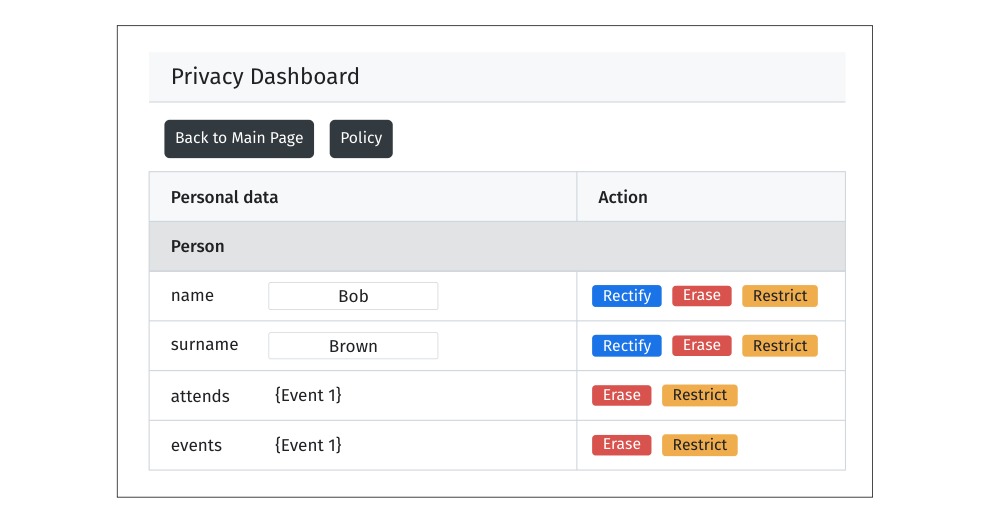
νActionGUI generated privacy dashboard. - Legal-grounds logging.
- Base security model for data subject rights.
- Necessary declared purposes that are automatically consented to upon registration.
Previous changelog
v1.1.0 — Second stable release
- Used for the Security Engineering master course HS 2025.
- Enhanced OCL enforcement support via the new standalone OCL-py library.
- Added a dockerized version.
- Introduced the language-server foundation for live editing and validation.
- Added an integration test suite for the approach.
v1.0.0 — First stable release
- Used for the Security Engineering master course HS 2024.
- Reorganized the prototype script.
- Added model validations that automatically invokes before the code generation complete.
- Added unit test suite for each modeling languages.
- Added the anonymous role for unauthenticated users.
v0.0.1 — Prototype
- Initial model-driven generator accompanying the PoPETs 2024 paper.
Installation & Usage
Requirements
- Docker (recommended), or
- Python 3.11+ and a Java runtime (for ANTLR, used when building the model parsers).
Setting up the environment
The quickest way is the bundled Docker container, which ships with all dependencies, the model parsers, and the nuactiongui command pre-installed.
- Start the container:
docker compose up --build --detach
This builds the image and starts a container namednuactiongui. - Open a shell inside the container:
docker exec -it nuactiongui bash
The shell prints the νActionGUI banner with the Python virtual environment already activated.
Building from source (without Docker)
- Create and activate a Python virtual environment:
python3 -m venv .venv
source .venv/bin/activate
- Install the Python dependencies:
pip install -r requirements.txt
- Build the model parsers (requires Java; uses ANTLR 4.13.0):
make clean && make grammars
- Install the OCL-py library and the νActionGUI package:
pip install ./ocl-py
pip install -e .
The last step installs thenuactionguicommand.
Usage
Once installed, the nuactiongui command generates web applications from your models. Model and output paths are resolved relative to the current directory.
Generating an application
- Place your project (the
.dtm,.stm, and.ptmmodels) in a subdirectory ofexamples/, then run:nuactiongui -p <project_folder> -i examples -o output
For example, with the bundled project:nuactiongui -p EventPlatform -i examples -o output. The generated app is written tooutput/<project_folder>.
Regenerating the security & privacy enforcement
- To regenerate only the security and privacy artifacts (preserving your business logic), run:
nuactiongui -p <project_folder> -i examples -re
Note: if the data model changed, remove the existing database atoutput/<project_folder>/instance/before running again.
Running the Project
- Navigate to the generated project directory:
cd output/<project_folder>
- Run the Flask application:
flask --app app.py run --host=0.0.0.0
The app is then reachable atlocalhost:5000. This is a development server — do not use it in production.
Copyright Institute of Information Security, ETH Zurich
Permission is hereby granted, free of charge, to any person obtaining a copy of this software and associated documentation files (the “Software”), to deal in the Software without restriction, including without limitation the rights to use, copy, modify, merge, publish, distribute, sublicense, and/or sell copies of the Software, and to permit persons to whom the Software is furnished to do so, subject to the following conditions:
The above copyright notice and this permission notice shall be included in all copies or substantial portions of the Software.
THE SOFTWARE IS PROVIDED “AS IS”, WITHOUT WARRANTY OF ANY KIND, EXPRESS OR IMPLIED, INCLUDING BUT NOT LIMITED TO THE WARRANTIES OF MERCHANTABILITY, FITNESS FOR A PARTICULAR PURPOSE AND NONINFRINGEMENT. IN NO EVENT SHALL THE AUTHORS OR COPYRIGHT HOLDERS BE LIABLE FOR ANY CLAIM, DAMAGES OR OTHER LIABILITY, WHETHER IN AN ACTION OF CONTRACT, TORT OR OTHERWISE, ARISING FROM, OUT OF OR IN CONNECTION WITH THE SOFTWARE OR THE USE OR OTHER DEALINGS IN THE SOFTWARE.